Score Weight Distribution
Each product receives a score from 0 to 10 in four categories. The final weighted score is calculated as:
Optimal Toileting Position
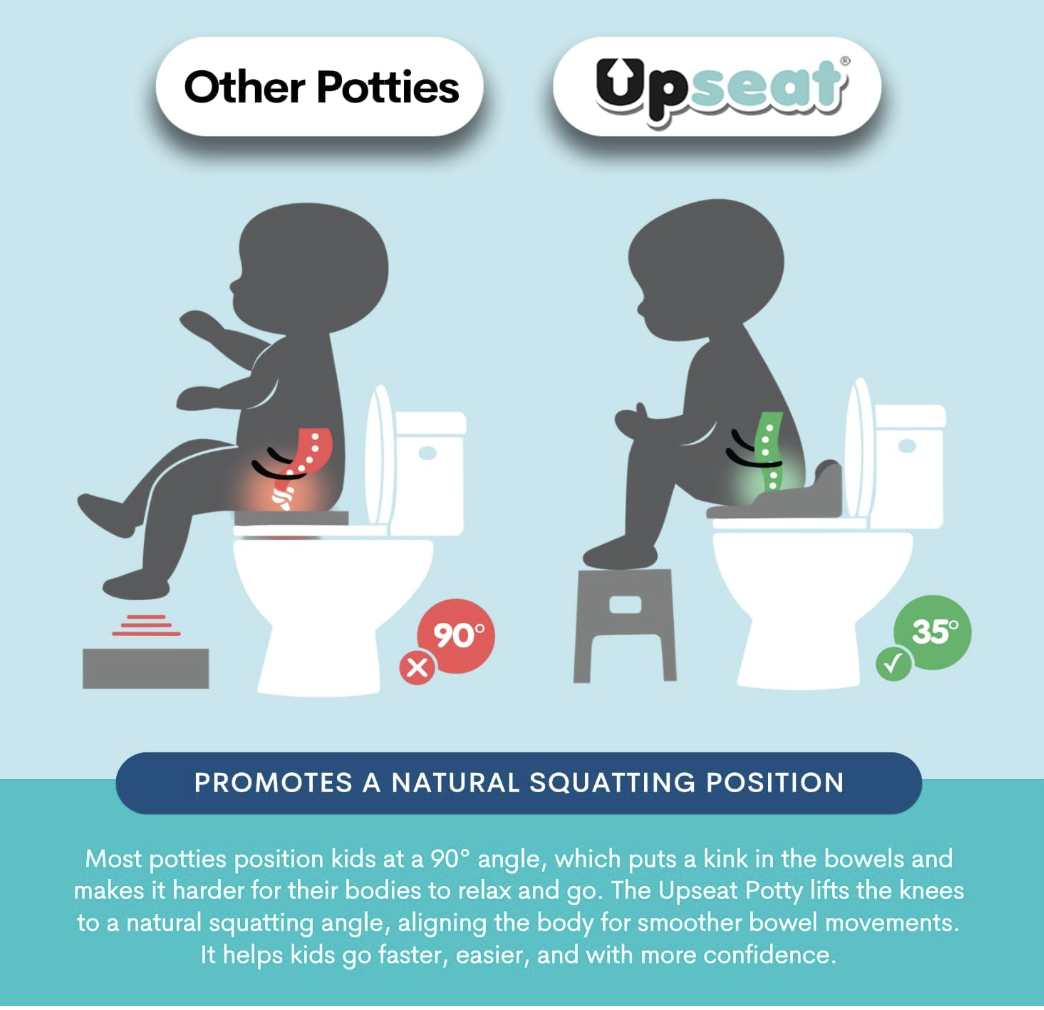
Elbows on knees, knees above hips, feet supported — the position that relaxes the puborectalis and straightens the anorectal angle.
PT-Recommended Positioning
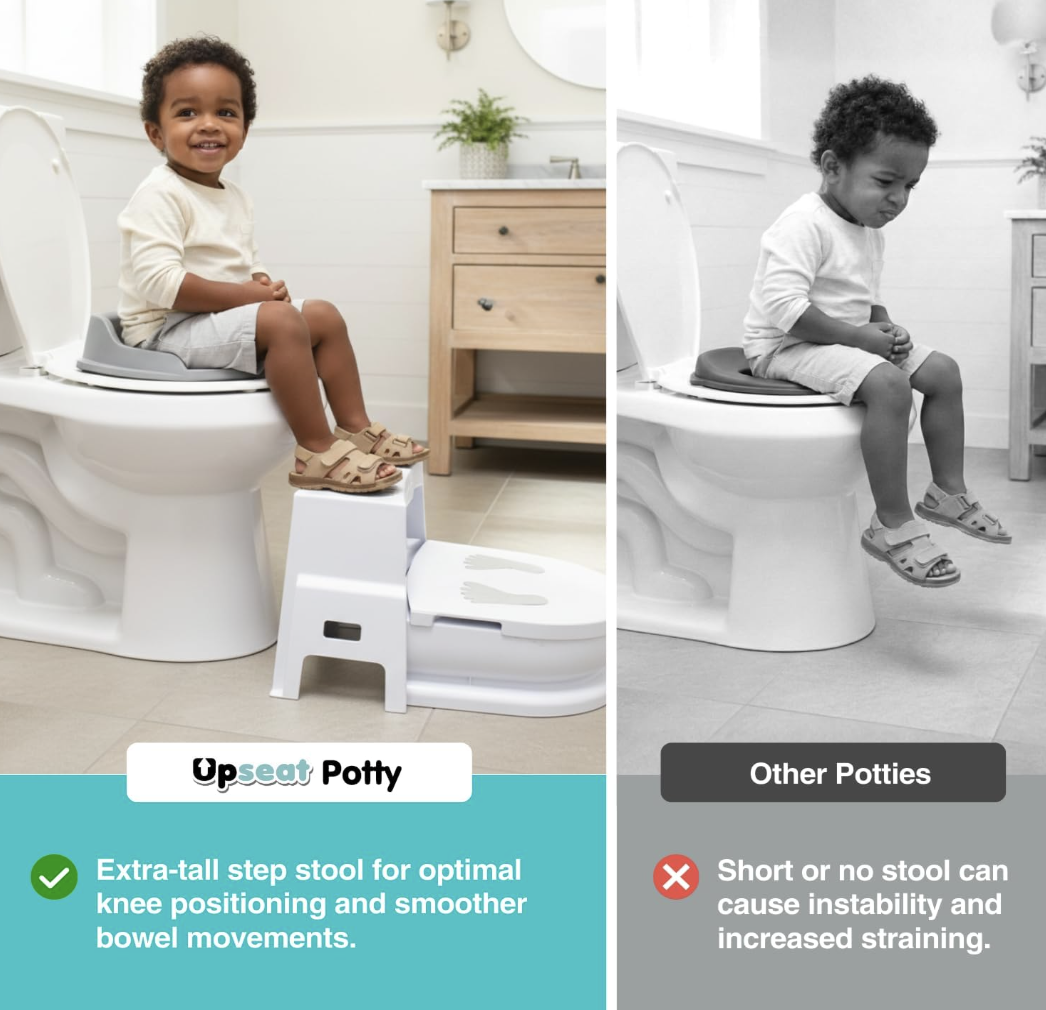
Key elements: feet supported and spread wide, knees higher than hips, child leaning slightly forward, seat fits them comfortably.
Ergonomics
The most heavily weighted category, reflecting the scientific consensus that proper toileting posture is the single most important factor in healthy bowel development.
Evaluation Criteria
- 1Does the seat promote knees-above-hips positioning?
- 2Is the seat contoured to support the natural squat posture?
- 3Does the design facilitate puborectalis muscle relaxation?
- 4Is the anorectal angle optimized for easier elimination?
- 5Was the product developed with input from physical therapists?
Physical Therapy Context
The puborectalis muscle acts as a sling around the rectum. When seated in a standard flat position, this muscle remains contracted, creating a kink in the rectum (approximately 100° anorectal angle). When the knees are elevated above the hips — mimicking a natural squat — the puborectalis relaxes, straightening the anorectal angle to approximately 135°, allowing for easier, more complete bowel evacuation without straining.
Safety
Safety encompasses structural stability, material safety, and features that prevent accidents during use.
Evaluation Criteria
- 1Non-slip base or grip mechanism
- 2BPA-free, non-toxic materials
- 3Adequate splash guard design
- 4Structural stability under load
- 5Weight capacity appropriate for age range
- 6No pinch points or sharp edges
Physical Therapy Context
Physical therapists emphasize that a child must feel secure and stable during toileting. Anxiety about falling or instability can cause the pelvic floor muscles to tense, directly counteracting the relaxation needed for healthy elimination. A secure, stable seat is therefore not just a safety feature — it's an ergonomic one.
Ease of Use
Practical usability for both parents and children, including cleaning, setup, and daily convenience.
Evaluation Criteria
- 1Easy to clean (removable bowl, smooth surfaces)
- 2Simple setup with no tools required
- 3Child can use independently
- 4Lightweight and portable
- 5Intuitive design for toddlers
- 6Multi-stage or convertible functionality
Physical Therapy Context
Consistency is key in potty training. Physical therapists recommend that the potty be easily accessible and simple enough for the child to use independently. Products that are difficult to clean or set up may lead to inconsistent use, undermining the training process.
Value
Overall value proposition considering price, longevity, and the number of functions the product serves.
Evaluation Criteria
- 1Price relative to features offered
- 2Multi-stage functionality (potty + trainer + stool)
- 3Durability and build quality
- 4Longevity across potty training stages
- 5Replacement part availability
- 6Warranty or satisfaction guarantee
Physical Therapy Context
A product that grows with the child through multiple stages of potty training — from standalone potty to toilet adapter to step stool — provides significantly better value than single-function alternatives, even at a higher initial price point.
Expert Sources
Our methodology is informed by published guidance from leading physical therapy organizations and pelvic health specialists.
"Place your feet hips-width apart on a stool. This will raise your knees above your hips. Lean forward slightly. … The pressure of your thighs on your lower belly is also helpful."
"When you elevate your legs (knees above hips), your sphincter aligns straight, and the puborectalis muscle becomes relaxed. This allows for an ease of elimination of your bowels."
"Knees higher than hips: Raising the knees above the level of the hips … mimics a squat position and straightens the rectal angle, allowing stool to pass more easily without excessive straining."
"When the knees are above the hips, the anal canal aligns in a way that promotes easier bowel movements … A simple stool, bench, or even a thick book can … help raise your knees above your hips."
Frequently Asked Questions
Why is Ergonomics weighted at 40%?
Physical therapists consistently emphasize that proper toileting posture — specifically, positioning the knees above the hips to mimic a natural squat — is the single most important factor for healthy bowel movements. This position relaxes the puborectalis muscle and straightens the anorectal angle, reducing straining and promoting complete elimination. We weight ergonomics highest because it directly impacts your child's long-term pelvic health.
What does "knees above hips" mean for potty training?
When a child sits with their knees elevated above hip level, it mimics the natural squatting position humans evolved to use for elimination. This posture straightens the rectoanal canal from approximately 100° to 135°, allowing stool to pass more easily. The Upseat Potty is the only product in our comparison specifically designed to achieve this positioning.
Are your reviews independent?
Our scoring methodology is based on published physical therapy research and objective feature analysis. Each product is evaluated against the same criteria, with scores reflecting measurable attributes like ergonomic design, safety features, and multi-stage functionality. We include affiliate links and may earn commissions, but our scores are determined by our standardized methodology.
What is the puborectalis muscle?
The puborectalis is a U-shaped muscle that wraps around the junction of the rectum and anal canal. When contracted (as in a standard seated position), it creates a kink that helps maintain continence. When relaxed (as in a squat position with knees above hips), it allows the rectoanal canal to straighten for easier bowel movements. This is why physical therapists recommend elevated knee positioning during toileting.